

9 Days The Ultimate Rwanda Explorer
Rwanda is one of Africa's most extraordinary destinations — a small, densely forested nation whose landscapes shift from open savannah to ancient rainforest to mist-wreathed volcanic mountains within a single day's drive. This nine-day signature journey brings together the full breadth of that experience: the sweeping game plains of Akagera, alive with lion, elephant, and rhino; the ancient canopy of Nyungwe, where chimpanzees and colobus monkeys move through one of the continent's oldest forests; and the Virunga Volcanoes of the north, where a face-to-face hour with mountain gorillas in their natural habitat remains one of the most profound wildlife encounters on the planet. Woven through it all is the story of Rwanda itself — a country whose history, resilience, and remarkable conservation success story are inseparable from the landscape. Planned and accompanied from start to finish by Sankofa Africa Safaris.
Your Rwanda journey begins at Kigali International Airport, where your Sankofa Africa Safaris guide meets you in the arrivals hall and transfers you to your hotel through a city that consistently surprises first-time visitors — clean, orderly, and set across a series of dramatic hills whose green flanks are terraced with houses, gardens, and the occasional rooftop view that takes in the full scale of this compact but enormously energetic capital. Rwanda's transformation over the past three decades is visible everywhere in Kigali: in the quality of its roads and markets, in the confidence of its street life, and in the ease with which a visitor can move through a city that has rebuilt itself with remarkable intentionality after the devastation of 1994.
The afternoon includes a guided city experience with stops at scenic hilltop viewpoints across the Kigali skyline, followed by an optional visit to the Kigali Genocide Memorial — a soberly and thoughtfully presented site that documents Rwanda's history, the events of the genocide, and the country's long path of reconciliation and renewal. The memorial is emotionally demanding but enormously important: visitors who engage with it find that it deepens and contextualises every subsequent day of the journey in ways that no wildlife briefing can achieve. In the evening, a welcome dinner introduces Rwandan cuisine and opens the detailed journey briefing — eight days of safari, primate tracking, forest trekking, and mountain landscapes laid out clearly, with all expectations set and all questions answered.
After breakfast, your safari vehicle heads eastward from Kigali and the landscape begins one of the most striking transitions in Rwandan geography: the dense, hilly terrain of the capital's highlands giving way gradually to the open, bronze-toned savannah of the east — a world of acacia woodland, papyrus swamps, and glittering lakes that feels entirely removed from the green intensity of the forest highlands you have just left. The drive itself is a pleasure — Rwanda's roads are among the best maintained in the region, and the passing countryside of rural villages, banana groves, and cattle-grazed hillsides is a constant reminder of the density of human life woven through even the country's most scenic landscapes.
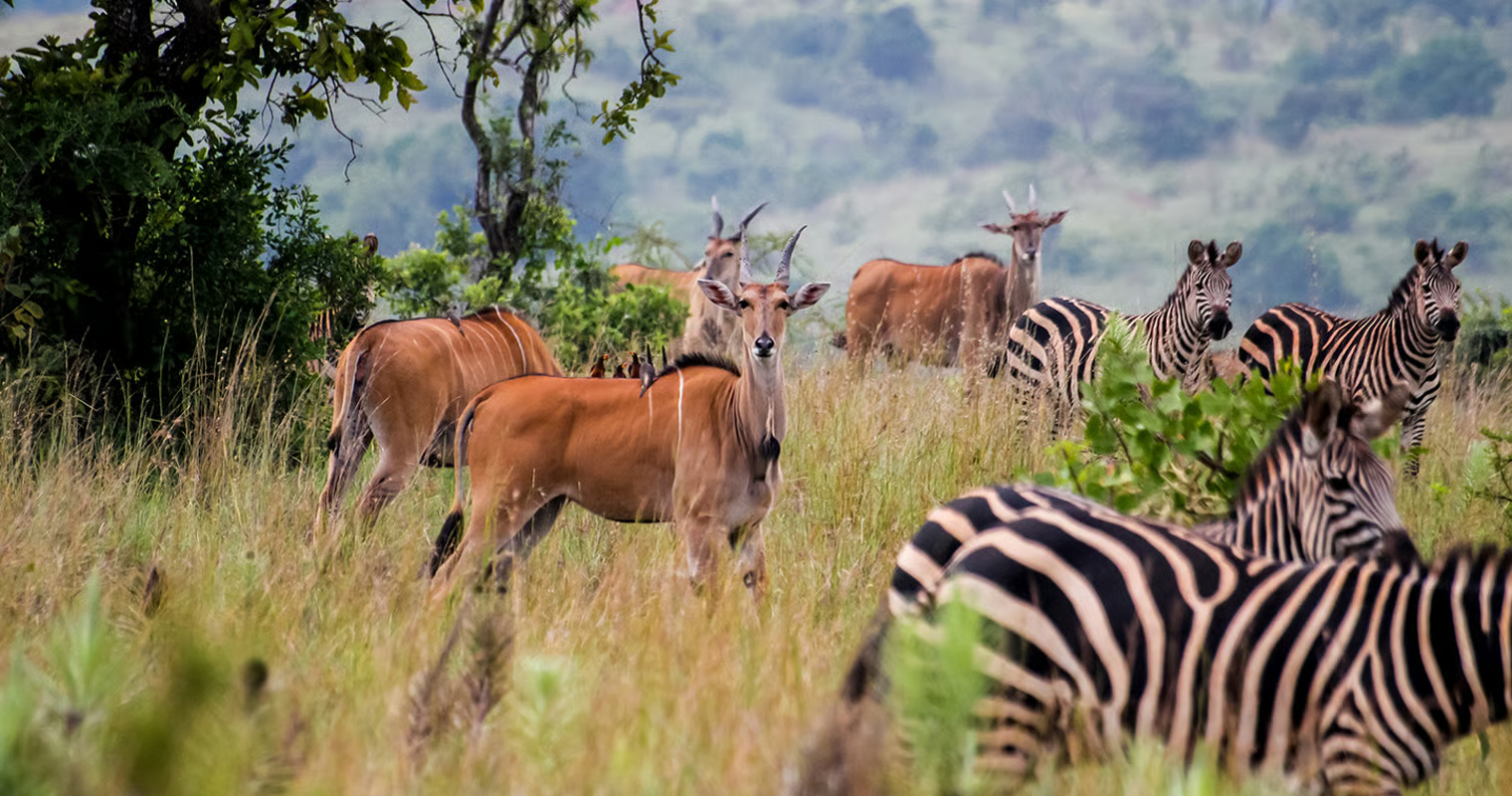
Akagera National Park — Rwanda's only savannah park, stretching along the Tanzanian border — was substantially rehabilitated from the mid-2010s onward following the reintroduction of lions in 2015 and black rhinos in 2017, making it one of central Africa's most remarkable conservation recovery stories. Your afternoon game drive enters the park under expert guide narration, with the landscape delivering almost immediately: herds of giraffe browsing the acacia tops, zebra and kob antelope moving through open grassland, buffalo at the lake margins, and the first evening light turning the savannah to gold over the distant water. The diversity of birdlife in Akagera is formidable — over 500 species recorded — and your guide begins introducing the most distinctive and photogenic species as you settle into the rhythm of the safari vehicle.
The early morning game drive — beginning at first light when the savannah is at its most active — targets Akagera's full roster of major species. Lions, reintroduced just a decade ago, have established territories throughout the park and are regularly encountered on morning drives when they are still active after the cool of the night. Elephants, moving in family herds, gather near the lake margins in the early hours; black rhinos, though more elusive, are tracked with the support of park rangers who maintain GPS monitoring data. Giraffes, leopards, buffalo herds, and the full complement of antelope species — topi, impala, waterbuck, reedbuck, bushbuck — fill the landscape between the park's signature larger encounters. Your guide reads the terrain with practiced attention, and even a morning that yields no lion sighting is dense with wildlife, movement, and the quality of light that makes Akagera's savannah one of east Africa's most photogenic environments.
The afternoon transitions entirely to water. Lake Ihema — the largest of Akagera's chain of lakes, fed by the Akagera River along the Tanzanian border — offers a boat safari experience that is qualitatively different from anything possible on a game drive: the perspective is low and intimate, the pace is dictated by the current and the wildlife rather than any road, and the animals encountered respond very differently to a boat than to a vehicle. Hippos rise, yawn, and submerge at close range; enormous Nile crocodiles hold position on sandbanks in prehistoric stillness; African fish eagles launch from waterside perches in the luminous afternoon light. The density of herons, storks, kingfishers, and waders along the lakeshore turns the afternoon into one of the expedition's most reliably spectacular wildlife experiences regardless of what the morning has or has not delivered on land.
The drive south from Akagera to Nyungwe is one of the great cross-country journeys of Rwandan travel — a half-day transit through an extraordinary sequence of landscapes that illustrates the country's remarkable geographic compression. From the flat savannah and lake country of the east, the terrain rises steadily through the central plateau, passing through rural trading towns, hillside markets, and the vivid patchwork of terraced smallholder farms that cover Rwanda's interior hillsides in a mosaic of green that has earned the country its reputation as the Land of a Thousand Hills. The passage through the tea plantation zone in the south is particularly striking: kilometre after kilometre of immaculate tea hedge ascending every available slope, with pickers moving through the rows in the soft afternoon light.
As the road approaches Nyungwe Forest National Park, the landscape transforms again — the open hillsides giving way to a dense, dark, and enormously ancient wall of forest that rises from the road's edge and continues unbroken across an enormous elevated plateau. Nyungwe is one of Africa's oldest and most species-rich montane rainforests: dating back at least a million years, it supports over 1,000 plant species, more than 300 bird species, and thirteen primate species including the chimpanzee communities you will track tomorrow. Your lodge — set in the forest or at its immediate edge — offers a first encounter with the sounds of Nyungwe at night: an acoustic environment dominated by tree frogs, nocturnal insects, and the occasional distant call of a primate that is unlike anything experienced in the savannah country of the preceding two nights.
An early breakfast precedes the transfer to the forest for chimpanzee tracking — one of the defining experiences of Rwanda's primate trail and one that differs fundamentally from the mountain gorilla encounter that awaits later in the journey. Nyungwe's habituated chimpanzee communities are tracked by experienced rangers who locate the group by their calls — the explosive pant-hoots and tree-drumming that carry through the forest at extraordinary volume — before guiding your group through dense undergrowth to establish visual contact. Chimpanzees are active, unpredictable, and intensely social, and an encounter with a habituated group — watching individuals groom, squabble, play, and travel through the canopy — is exhilarating and chaotic in a way that differs completely from the quieter, more contemplative quality of a gorilla sighting. The shared ancestry between chimpanzees and humans is viscerally apparent at close range, and the tracking experience invariably produces the kind of moment that stays with travellers for the rest of their lives.
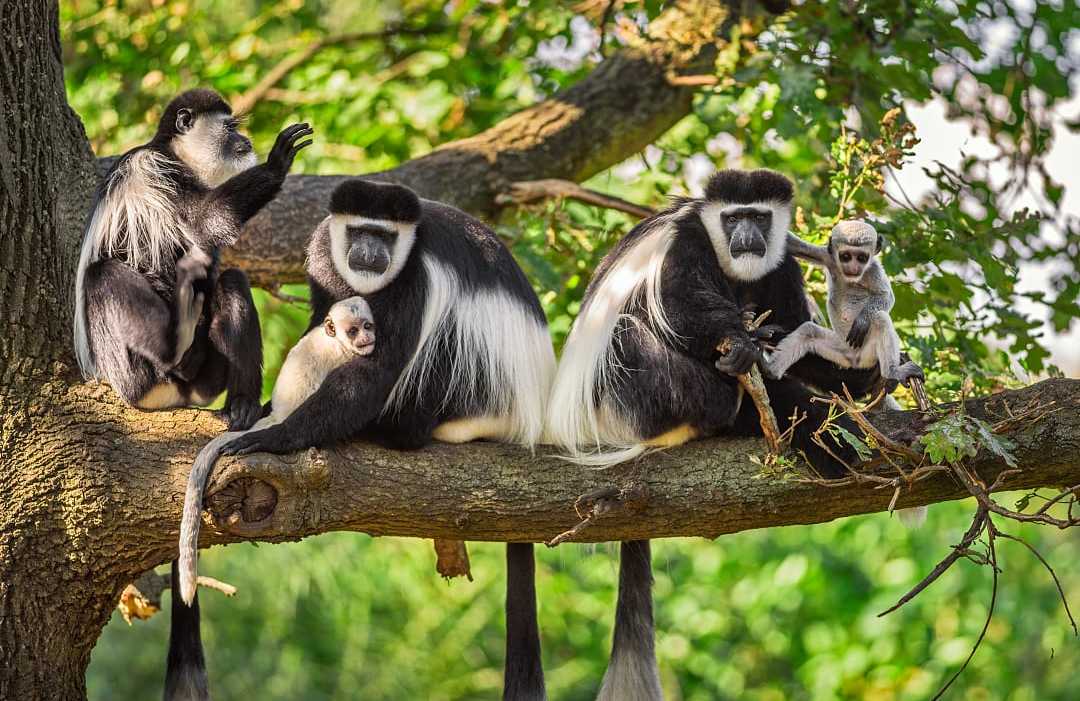
In the afternoon, the Nyungwe Canopy Walk offers a completely different perspective on the same forest — suspended high above the forest floor on a network of suspended walkways and platforms, you move through the mid-canopy at heights of up to fifty metres, with panoramic views across an unbroken ocean of ancient treetops extending to the Burundian border and beyond. The canopy level is a different ecological world: sunbirds, turacos, and bee-eaters move through the flowering trees at eye level; colobus monkey troops swing between the emergent trees that rise above the walkway level; and the view at dusk — the forest dissolving into purple shadow beneath a vast sky — is one of Nyungwe's most enduringly beautiful experiences. A full day in the forest, and one of the most physically and emotionally rewarding of the journey.
The northward drive from Nyungwe to the Volcanoes region is the longest transit of the journey and simultaneously one of its most scenic — a cross-country passage through the full breadth of Rwanda's interior, covering terrain that ranges from the dense forest of the south through the cultivated central plateau to the volcanic north. The route passes through Kigali, offering an opportunity for a fuel stop and a final urban meal before the landscape opens again into the rolling hills and lake country of the northwest, where the great conical profiles of the Virunga Volcanoes begin to emerge above the horizon hours before you arrive — initially as faint dark shapes behind cloud, then progressively more dramatic as the road climbs toward the mountain foothills and the temperature drops noticeably with the altitude.
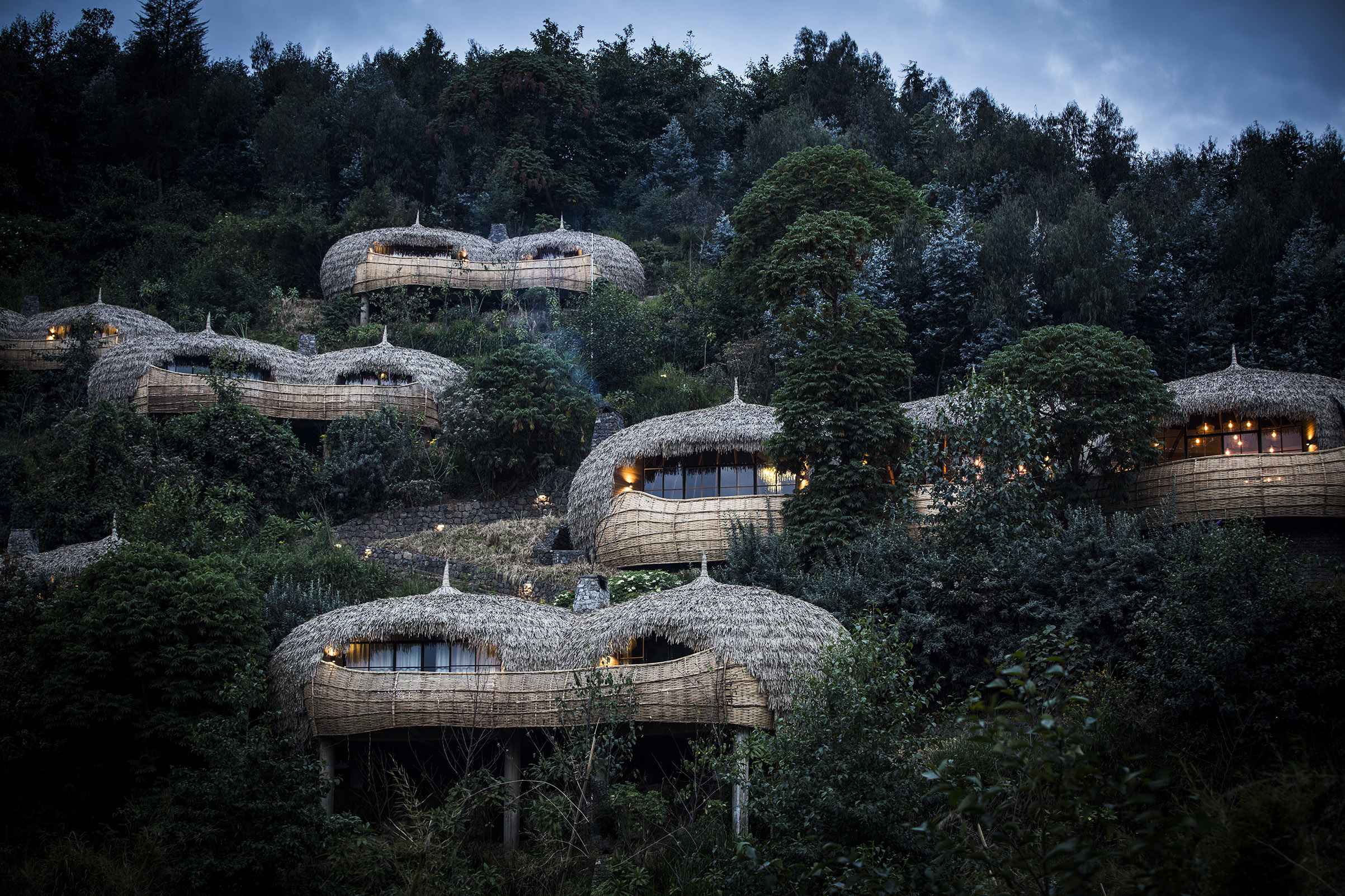
Arrival in the Volcanoes National Park area — at the foot of the Virunga chain, which straddles the borders of Rwanda, Uganda, and the DRC — marks the emotional climax of the journey's build. The landscape here is unlike anywhere else Rwanda has to offer: a broad, cultivated plain bounded to the north by a wall of forested volcanic peaks rising to over four thousand metres, with the bamboo zone that harbours the mountain gorillas visible as a dark band above the agricultural land. Your lodge, set against this backdrop, is reached in the late afternoon as mist rolls down from the upper forest and the light thickens over the volcanoes. The evening briefing on tomorrow's gorilla trekking — group assignments, ranger communication protocols, what to expect in terms of terrain and animal behaviour — is conducted with the gorilla forest visible from the lodge terrace.
The day that defines the journey. An early breakfast is followed by the transfer to Volcanoes National Park headquarters, where trekking groups assemble for the ranger briefing — a meticulous and unhurried introduction to gorilla trekking protocols, conservation rules, health guidelines, and the specific family group to which your party has been assigned based on fitness and mobility assessments. The gorilla families of Volcanoes National Park — habituated over decades of patient work by researchers and rangers — vary in size from small bachelor groups to large, complex family units led by a dominant silverback whose presence is felt long before the animals are visually encountered.
The trek itself moves from the park boundary through bamboo forest and dense rainforest, following ranger radio communication with trackers who have been locating the family since dawn. Duration varies between one and six hours depending on how far the gorillas have moved overnight — but the uncertainty is part of the experience, and the moment of first visual contact with the family is no less extraordinary for being unpredictable. The permitted hour in the presence of the gorillas passes with a quality of heightened attention that most visitors describe as unlike anything else in their lives: a silverback resting three metres away, juveniles playing in the undergrowth, infants peering from behind their mothers with boundless curiosity. It is a deeply emotional, conservation-grounded encounter, and the return trek to the trailhead is typically conducted in a reflective quiet that the forest seems to encourage. Lunch at the lodge, and a long, unhurried afternoon to absorb what the morning has delivered.
The final full day in the Volcanoes offers a choice of two very different but equally rewarding experiences — selected based on your interests, physical preference, and what the gorilla day has left you most curious to follow up.
Whichever experience you choose, the afternoon is left entirely at leisure — a rare and welcome pause in a journey that has moved continuously through some of Africa's most demanding and rewarding wildlife environments. The final evening at the lodge, with the Virunga Volcanoes fading into cloud above the treeline, is an appropriate close to a week of sustained natural immersion.
The final morning begins with breakfast at the lodge as the Virunga peaks emerge from their overnight cloud cover in the early light — a last sight of the mountain landscape that has framed the most emotionally intense days of the journey. The drive south to Kigali follows the scenic route back through Rwanda's volcanic northwest, with optional stops at viewpoints over Lake Kivu — the great western Rift Valley lake that forms Rwanda's border with the DRC — and at artisan cooperatives along the route where weavers, sculptors, and ceramic artists working in Rwanda's distinctive contemporary craft tradition sell directly and with complete provenance. The quality and originality of Rwandan craft work is consistently one of the journey's most pleasant surprises for travellers who expect generic tourist souvenirs and instead find genuinely distinctive and collectible objects.
Arrival in Kigali allows time for any final exploration of the city before the transfer to Kigali International Airport for your onward flight. Your Sankofa Africa Safaris guide accompanies you to the departure terminal, and the expedition ends here — with the gorillas of the Virunga, the chimpanzees of Nyungwe, the lions of Akagera, and the full arc of Rwanda's landscape behind you, and a country that has changed your understanding of what African conservation, resilience, and natural beauty can achieve.
| Activity | Permit Cost | Notes |
|---|---|---|
| Mountain Gorilla Trekking | USD 1,500 / person | Strictly limited permits — book early |
| Chimpanzee Tracking | USD 90 / person | Nyungwe Forest National Park |
| Golden Monkey Tracking | USD 100 / person | Volcanoes National Park, Day 8 option |
All permits are included in the package price and arranged by Sankofa Africa Safaris.
| Travellers | Price Per Person | Notes |
|---|---|---|
| Solo (1 pax) | USD 8,950 | Single supplement; private vehicle & guide |
| 2 people | USD 7,600 | Shared transport; shared guiding costs |
| 3 people | USD 6,900 | Strong per-head saving vs. solo or pair |
| 4 people | USD 6,350 | Good balance of cost and group flexibility |
| 5 people | USD 6,000 | Approaching maximum shared efficiency |
| 6 people | USD 5,750 | Lowest per-head cost; luxury upgrades available |
Prices based on mid-range accommodation. Luxury upgrades available on request. Subject to permit availability and seasonal lodge rates. Single supplement applies for solo travellers.