

5 days Uganda gorilla and chimpanzee tracking Safari
This 15-day safari is the most complete way to experience Uganda and Rwanda — combining the best of both countries' wildlife, landscapes, and cultures in a single, logically routed journey. The itinerary travels north from Kampala to Murchison Falls National Park for big game and the legendary Nile boat cruise, stops at Ziwa Rhino Sanctuary for on-foot rhino tracking, then swings southwest to Kibale Forest for chimpanzee tracking, Queen Elizabeth National Park for the Kazinga Channel cruise and tree-climbing lions, and Bwindi Impenetrable Forest for mountain gorilla trekking. Crossing into Rwanda, you spend a full day in Kigali exploring the city's cultural and historical sites, track golden monkeys in the bamboo forests of Volcanoes National Park, and close the safari with a second mountain gorilla encounter on the slopes of the Virunga volcanoes. Arranged from first pickup to final airport drop-off by Sankofa Africa Safaris.
Your Sankofa Africa Safaris driver-guide meets you at Entebbe International Airport and transfers you to your hotel in Kampala on a 45-minute drive that skirts the northern shore of Lake Victoria and offers your first view of Uganda's lush equatorial landscape. In the afternoon, an orientation drive through Kampala takes in the Old Kampala Hill and the striking Gaddafi National Mosque, the panoramic views from Kololo Hill, the bustling Nakasero market, and the Uganda Crafts 2000 cooperative, giving you a grounding in the city before the safari proper begins. If time allows, a visit to the Kasubi Royal Tombs — a UNESCO World Heritage Site and the sacred burial ground of the Buganda Kingdom's kings — provides excellent cultural context for the journey ahead through Uganda's diverse heartlands. Over dinner, your guide walks you through the full 15-day itinerary, covering permits, packing requirements for each destination, border logistics, and what to expect at every stop, before an early night sets you up for the long drive north tomorrow.
Departing Kampala by 6:30 AM on the Masindi highway heading north, you make the most of your first major stop — Ziwa Rhino and Wildlife Ranch, located approximately 3 hours from Kampala and the only place in Uganda where you can see wild rhinoceros. Armed ranger escorts lead your group on a 1–2 hour walk through the open ranch grassland to locate the sanctuary's growing population of over 33 southern white rhinos; this completely on-foot encounter, often within metres of the animals, is thrillingly intimate and very different from any vehicle-based rhino sighting, and the $40 tracking fee goes directly into Uganda's long-term rhino reintroduction programme. After lunch near Masindi, you continue north into the dramatic Rift Valley escarpment and enter Murchison Falls National Park — Uganda's largest national park — arriving at your north-bank lodge in the late afternoon in time for a brief evening game drive along the Albert Nile, where you are likely to spot elephant, buffalo, and the park's resident Uganda giraffes before dinner and an early night ahead of tomorrow's full activity day.
A dawn game drive along the north bank of the Albert Nile launches the day at first light — this is prime time for lion activity, and the northern circuit's open savannah supports some of Uganda's largest elephant herds, with groups of 50 to 100 individuals commonly seen moving between the water and the woodland in the cool morning hours, alongside Uganda's only population of Rothschild's giraffe, one of the world's most endangered giraffe subspecies. After returning to the lodge for a full hot breakfast, the afternoon belongs to the Nile launch cruise — a 2-hour boat journey upriver from Paraa to the base of Murchison Falls, passing through one of the world's highest concentrations of Nile crocodiles and hippos, with herds of buffalo and elephant drinking at the riverbank and Goliath herons, African skimmers, and kingfishers working the water alongside the boat, before the Nile itself narrows from 50 metres to just 7 metres and thunders through a gap in the rock in what David Livingstone described as "the most beautiful scene I had witnessed in Africa." The evening game drive back to the lodge offers a second chance at any big cat sightings missed in the morning.
The morning begins with an optional short hike to the top of Murchison Falls — a 45-minute walk from the car park to the viewpoint directly above the point where the entire Nile is squeezed through the 7-metre rock gap, producing a wall of mist and sound that is one of the most viscerally powerful natural sights in East Africa, and well worth the early start before the heat of the day sets in. After breakfast and checkout, you make the long drive south out of Murchison Falls, crossing the Nile at Paraa ferry and heading through the Budongo Forest corridor before turning southwest towards Fort Portal — the drive passing through some of Uganda's most beautiful agricultural countryside, with rolling hills of tea, cassava, and banana giving way to the highland scenery of the Rwenzori foothills as you approach Fort Portal. You arrive at your lodge near Kibale Forest National Park in the early evening, with just enough time to settle in and hear your guide's briefing on tomorrow's chimpanzee tracking before dinner and an early night.
After an early breakfast you transfer to the Kanyanchu Visitor Centre for the 7:30 AM ranger briefing, where your group of up to 8 visitors is assigned to a habituated chimpanzee community and rangers — who have already tracked the community's overnight roosting position — walk you through forest etiquette, the tracking procedure, and the dos and don'ts of the encounter ahead. You enter Kibale's vivid, birdsong-saturated lowland tropical rainforest — home to approximately 1,500 chimpanzees and 13 primate species, the highest primate density in Africa — and follow the ranger team through the undergrowth until the first pant-hoot reverberates through the canopy and the forest erupts with movement around you. For up to one extraordinary hour you are in the company of the wild Kanyanchu chimpanzee community, watching them race through the canopy at speed, groom each other with focused attention, and occasionally drum on tree buttresses in full dramatic display — an experience that is electric, chaotic, and deeply moving in equal measure — before trekking back for a packed lunch at the forest edge. The afternoon is spent at the community-run Bigodi Wetland Sanctuary, a 2-hour guided walk through papyrus swamp bordering the forest that is outstanding for birdwatching and offers easy sightings of grey-cheeked mangabeys and L'Hoest's monkeys, with all entry fees retained entirely by the surrounding villages.
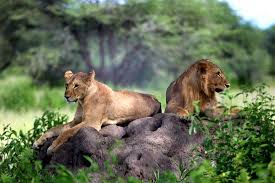
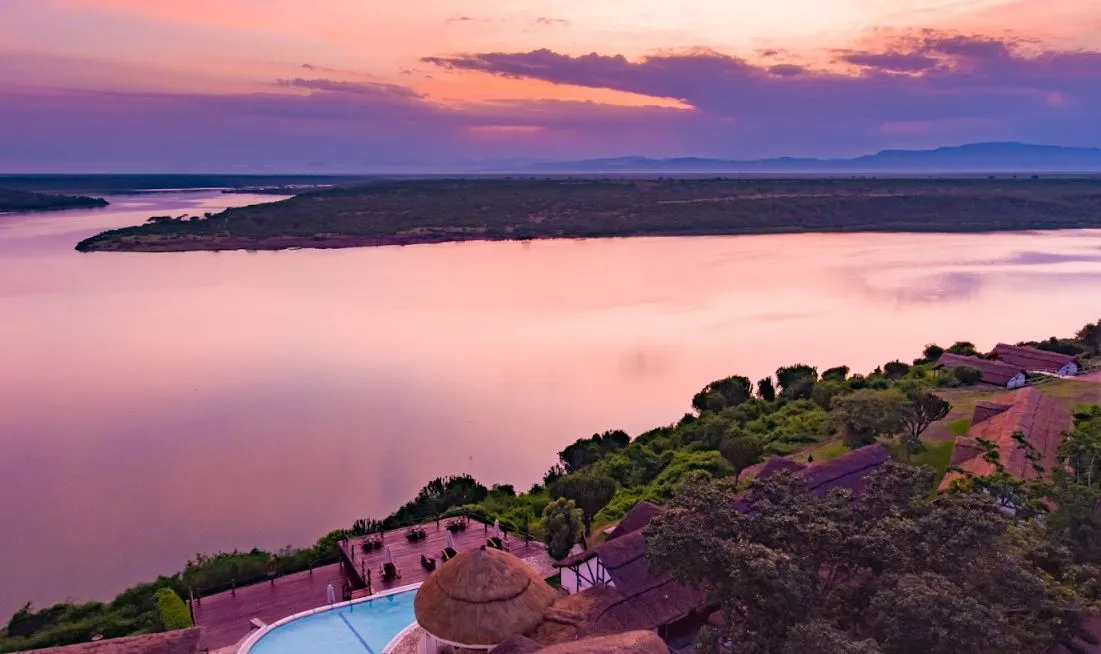
After breakfast and checkout, the morning begins with a leisurely drive through the extraordinary Fort Portal crater lakes — dozens of perfectly circular volcanic lakes in every shade of green and turquoise set into the tea-estate highlands south of the town, stopping at the Kyaninga and Nyinambuga viewpoints for photographs of one of Uganda's most distinctive and photogenic landscapes. The drive continues south as the highlands drop steeply into the wide flat plains of the Albertine Rift Valley and Queen Elizabeth National Park opens up before you, the Rwenzori Mountains forming a snow-capped backdrop to the northwest on clear days. After a lunch stop near the park entrance, you check into your lodge on the Mweya Peninsula — a dramatic headland at the confluence of Lake Edward and the Kazinga Channel, with panoramic views of hippos wallowing in the channel below and Uganda kob grazing the open plains — and the afternoon is spent on a game drive across the Kasenyi plains, the park's best area for lion and elephant sightings, where Cape buffalo graze in herds of hundreds and the golden evening light turns the savannah into one of Africa's great wildlife canvases.
The day starts before sunrise with a dawn game drive across the Kasenyi plains, the best time for lion activity in the park, with prides regularly tracked in the open grassland and the chance of a leopard sighting along the channel banks for attentive early risers — before returning to the lodge for a full hot breakfast on the veranda as hippos and African fish eagles provide the soundtrack below. The centrepiece of the day is the 2-hour Kazinga Channel boat cruise, widely considered one of Uganda's finest wildlife experiences: the 40-kilometre waterway connecting Lake George and Lake Edward holds an extraordinary concentration of hippos and Nile crocodiles visible at close range from the water, while elephants, buffalo, and waterbuck wade at the banks and an astonishing variety of waterbirds — pelicans, open-billed storks, malachite and pied kingfishers, yellow-billed egrets, and African skimmers — work the shallows alongside the boat. The afternoon offers either a second game drive or an optional walk into Kyambura Gorge — a dramatic sunken forest cut into the Queen Elizabeth plains, home to a small isolated community of wild chimpanzees and extraordinary even if the chimps are not encountered — before dinner at the lodge and a full briefing on the drive to Bwindi tomorrow.
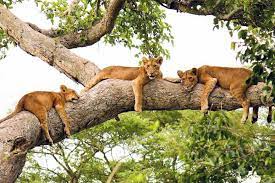
Departing the Mweya lodge by 6:30 AM, you drive south through the park to the remote Ishasha sector — the southernmost extension of Queen Elizabeth National Park bordering the Democratic Republic of Congo — where your driver-guide makes a methodical search of the landmark fig trees in which the park's famous tree-climbing lions habitually rest, a behaviour documented in only two places on Earth; allow at least 2 hours in Ishasha and plan your patience accordingly, as the reward of finding a pride draped across the branches against the deep sky of the rift valley is one of Uganda's most extraordinary wildlife moments. After a packed lunch, you leave the park and begin the steep climb east into the Kigezi highlands — the landscape shifting dramatically as the flat rift valley floor gives way to deeply terraced mountain ridges, every slope intensively farmed by the Bakiga people in a patchwork of green that is among Uganda's most beautiful rural scenery. You arrive at your Bwindi forest-edge lodge in the early evening, the 25,000-year-old ancient forest rising into mist all around, and after dinner your guide conducts a thorough gorilla trekking briefing covering the 7-metre rule, forest etiquette, what to wear and carry, and the physical demands of the terrain ahead of what will be the most extraordinary day of the entire safari.
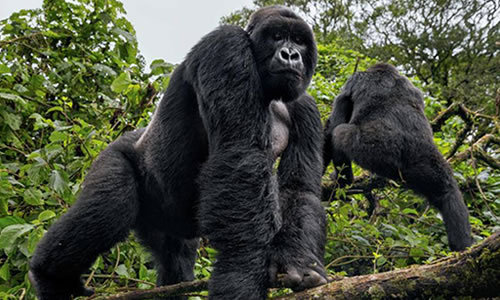
Rising before dawn for a hearty breakfast and final kit check — long sleeves, waterproof boots, rain jacket, at least 2 litres of water, and your camera — you drive to the Uganda Wildlife Authority headquarters where rangers conduct the final briefing, assign each visitor to a habituated gorilla family group, and offer you the chance to hire a local porter, which is strongly recommended on Bwindi's steep and often slippery terrain and puts direct income into the hands of the surrounding community. The trek into the ancient forest — a UNESCO World Heritage Site home to over 120 mammal species and 350 bird species — winds through dense montane rainforest, crossing streams on mossy log bridges and scrambling up slopes thick with wild ginger and tree ferns as your lead ranger communicates by radio with trackers who have followed the gorilla family since before dawn, with trek duration ranging from 45 minutes to 6 hours depending on where the family has moved overnight. When the ranger whispers "gorillas" and the undergrowth parts to reveal a silverback resting metres away — enormous, unhurried, and utterly magnificent in his own ancient environment — the effect is unlike anything else in wildlife travel: for sixty extraordinary minutes you observe the family at close range, watching mothers cradle tiny infants with tender precision, juveniles wrestling and tumbling down muddy slopes, and the silverback moving through his forest domain with slow, deliberate authority that makes it entirely clear who this forest belongs to. Each trekker receives an official Uganda Wildlife Authority Gorilla Trekking Certificate on return to the ranger station, and the late afternoon offers an optional Batwa Cultural Trail — a deeply moving guided experience with members of Bwindi's indigenous community sharing fire-making skills, medicinal plant knowledge, and the story of their ancestral relationship with the forest — before a celebratory dinner back at the lodge.
After a relaxed breakfast, the morning is spent at a nearby Bakiga community village — a warmly received cultural immersion with the highland people who have farmed the steep hillsides surrounding Bwindi for generations — where you watch women demonstrate traditional basket weaving using papyrus reeds, observe the brewing of omuramba (banana beer), witness the energetic Ekizino jumping dance performed in colourful traditional dress, and have the chance to purchase handcrafted baskets, beadwork, and woven items directly from the artisans, with all income remaining entirely within the community. A gentle guided nature walk along the Bwindi forest boundary in the late morning offers excellent birdwatching — Bwindi is home to 350 species including 23 Albertine Rift endemics — and a chance to spot L'Hoest's monkeys and forest duikers in the undergrowth before lunch. In the afternoon, you drive the short distance to Lake Bunyonyi — one of Uganda's most beautiful lakes, a deep crater lake ringed by steeply terraced hills and dotted with 29 forested islands — checking into a lakeside lodge and spending the evening on the water by dugout canoe as the sun sets over the Kigezi highlands, the most restful and visually striking overnight of the entire safari.
A peaceful final morning at Lake Bunyonyi — perhaps a dawn canoe paddle or a walk through the lakeside village — gives way to checkout and the drive east to the Katuna/Gatuna border post between Uganda and Rwanda, where your guide manages all immigration paperwork on your behalf and the crossing typically takes 30–60 minutes. As you enter Rwanda, the landscape shifts immediately into something distinctive: the famous terraced "thousand hills" roll in every direction, immaculately maintained and deeply beautiful, with tea estates, sorghum, and banana covering every hillside as far as the horizon, and the roads improving sharply within kilometres of the border post in a way that signals the meticulous order for which Rwanda is now celebrated across Africa. The drive east to Kigali takes approximately 2.5–3 hours from the border, and you arrive in the Rwandan capital in the early afternoon — time to check in, freshen up, and explore the city's vibrant Kimironko neighbourhood or the elegant cafés of Kigali Heights before dinner and a briefing from your guide on tomorrow's packed Kigali cultural day.
The day begins at the Kigali Genocide Memorial — the burial site of over 250,000 victims of the 1994 genocide and one of Africa's most carefully curated and important memorial sites, which documents Rwanda's history with dignity, detail, and an unflinching commitment to the principle "never again"; allow at least 90 minutes and enter with the quiet it deserves. From there, your guide leads a walking tour through Nyamirambo — Kigali's oldest and most characterful neighbourhood, a predominantly Muslim quarter of colonial-era mosques, tailoring workshops, street food stalls, and the lively community energy that stands in vivid contrast to the city's famously pristine modern centre, with the Nyamirambo Women's Centre running one of East Africa's most celebrated community walking tour programmes. After a proper Rwandan lunch of brochettes, isombe, and fresh tropical juice, the afternoon moves to the Inema Arts Centre — one of East Africa's most celebrated contemporary art spaces, showcasing vivid large-format paintings and sculptures by Rwandan artists exploring identity, memory, and resilience — before a final stop at Kimironko Market, Kigali's largest open-air market and the best place in Rwanda for craft shopping, including imigongo geometric art panels, agaseke peace baskets, soapstone carvings, and hand-printed kitenge fabrics. Your guide sets an early alarm for tomorrow: the golden monkey tracking briefing at Volcanoes NP begins at 7:00 AM, requiring a 5:00 AM Kigali departure.
Departing Kigali at 5:00 AM, the 2-hour drive northwest to Musanze through Rwanda's pre-dawn hills delivers the most dramatic sunrise view of the entire safari — the five great Virunga volcanoes (Karisimbi, Bisoke, Muhabura, Gahinga, and Sabyinyo) emerging from the mist one by one as the light intensifies, their perfectly conical profiles rising to over 4,500 metres against a clear sky. After the Rwanda Development Board briefing at Kinigi headquarters, you enter the bamboo zone of Volcanoes National Park for golden monkey tracking — one of Rwanda's most delightful and underrated wildlife experiences — following rangers through the dense bamboo forest to find a habituated troop of the endangered golden monkey (Cercopithecus kandti), a spectacularly coloured primate found only in the Virunga Massif, whose acrobatic leaps between bamboo stems and constant social chatter make for a wonderfully energetic hour utterly different in character from the gorilla encounter to come tomorrow. The afternoon is spent at the Iby'Iwacu Cultural Village near the park boundary — a community-run centre offering traditional Rwandan dance and music performances, hands-on craft demonstrations, archery, and a guided walk through a traditional homestead — giving you a genuinely engaging window into pre-colonial Rwandan culture before overnight in Musanze.
Arriving at the Rwanda Development Board headquarters at Kinigi by 7:00 AM sharp — Rwanda's gorilla trekking operation is precisely timed and punctuality is essential — you collect trekking poles from the gate, receive the final ranger briefing, and are assigned to your gorilla family group before entering Volcanoes National Park and beginning the ascent through cultivated potato fields at the park boundary, then into the bamboo zone, and finally into the high-altitude hagenia-hypericum forest where the gorilla families range on the steep Virunga slopes. Rwanda's trekking landscape is strikingly different from Bwindi's — more open in the bamboo sections, with giant lobelias, ancient lava flows draped in lichen, and the permanent volcanic mist that clings to the slopes creating an atmosphere of singular otherworldly drama — and the approaches to the habituated families tend to be somewhat shorter, typically 30 minutes to 3 hours. Your second mountain gorilla encounter — and for the overwhelming majority of visitors, one equally as powerful as the first despite the familiarity of the setting — gives you sixty minutes in the presence of a habituated family on the Virunga slopes, and having now sat with gorillas in two countries, in two entirely different ancient forest ecosystems separated by a border but united by the same animals, you carry an understanding of mountain gorillas that very few people on Earth will ever have. Each trekker receives a Rwanda Development Board Gorilla Trekking Certificate — your second gorilla certificate in two countries — before a celebratory lunch near Musanze and a final overnight in the shadow of the volcanoes.
After a final breakfast in Musanze with a last view of the Virunga volcanoes rising above the morning mist, you check out and make the 2-hour drive east to Kigali — the return journey through Rwanda's terraced thousand hills giving you one last look at one of Africa's most beautifully maintained countries as the city's skyline appears on the horizon. Depending on your departure time, the morning allows for any remaining craft shopping at Kimironko Market, a coffee stop in one of Kigali's excellent independent cafés, or a final walk through the immaculate streets of the capital before your Sankofa Africa Safaris guide delivers you to Kigali International Airport for your onward flight. The 15-day safari ends here — with Uganda's Big Five, mountain gorillas in two countries, Africa's finest chimpanzee tracking, on-foot rhino tracking, tree-climbing lions, the Murchison Falls Nile cruise, the Kazinga Channel, the beauty of Lake Bunyonyi, and the full cultural depth of both Uganda and Rwanda woven into a journey that most travellers describe as the most extraordinary of their lives.